The lowest capital cost
is rarely the lowest
whole-life cost.
Value engineering that only looks at capital cost transfers the saving onto the operator.
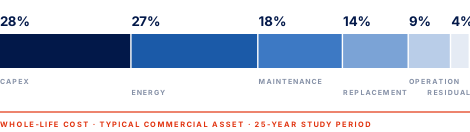
Life Cycle Cost Analysis evaluates the full financial consequence of a design decision, covering capital, energy, water, maintenance, replacement, operation and residual value, discounted to present value over a defined study period.
It gives the client an objective basis for choosing between alternatives, and gives the design team a defence for the specification that performs, expressed in the terms the decision is actually made in.
- Initial capital cost
- Energy cost
- Water cost
- Maintenance cost
- Replacement cost
- Operational cost
- Residual value
- Discounted cash flow
- Net Present Value
- Payback analysis
- Alternative design comparison
- Sensitivity & scenario testing
Set to the client's holding period or the asset's design life. A shorter period favours low capital cost.
The client's cost of capital. A higher rate discounts future savings and favours deferral.
Assumed movement in energy, water and labour cost over the period, tested for sensitivity.
Expected service life and replacement cycle of each system, and the residual value at the end.